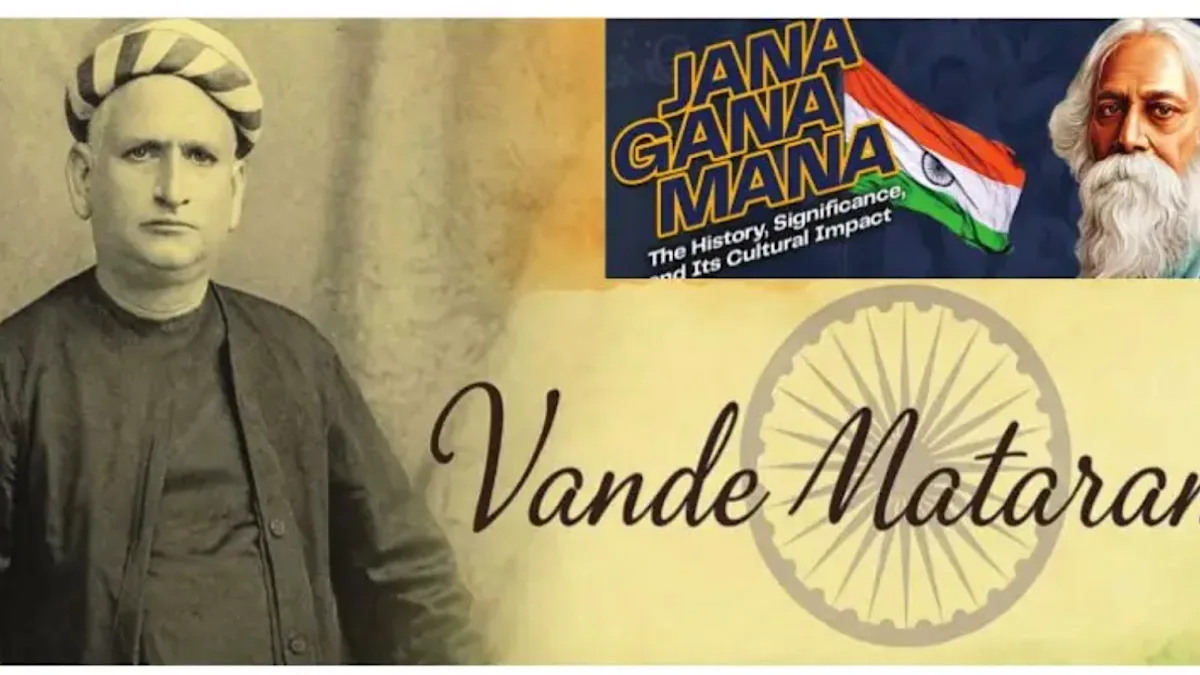
The recent controversy in the wake of the 150th anniversary of Vande Mataram is unjustified and unwarranted. After the ministry formation in 1937, Hindu-Muslim tension peaked in United Bengal. A K Fazlul Haq became the chief minister of Bengal and the Congress did not join his coalition government in spite of Haq’s keen desire. The differences became acute, with the Muslim leadership spearheading a movement against Vande Mataram for its Hindu symbolism and praise of Hindu Gods, and the symbols of Calcutta University, Shree and lotus were at the centre of a controversy that forced the central leadership of the Congress to intervene.
Rabindranath Tagore, when consulted by the Congress leadership, approved the singing of the first two stanzas of the Vande Mataram as the National Song. In October 1937, in an article published in the Visva Bharati News, Krishna Kriplani argued that the song Vande Mataram was totally incompatible with the Congress creed of non-violence and secularism and, therefore, could not become the national anthem. Tagore, who composed the tune of the song in 1896, expressed serious reservations about the song and during the celebration of his 70th birthday gave a call of Vande Vratanam instead of Vande Mataram. The Muslims objected to the song also as it was a salutation to Goddess Durga.
Advertisement
Orthodox Hindus felt that the song’s historical background and its total integration with the nationalist cause made it ideal as a national anthem. In the midst of this controversy, Subhas Chandra Bose privately solicited Tagore’s views on the song. The poet replied that Vande Mataram was appropriate as part of Anandamath, a literary work, but that it was inappropriate as a National Anthem. He added in a letter to Subhas “the core of Vande Mataram is a hymn to Durga; this is so plain that there can be no debate about it. Of course, Bankim Chandra does show Durga to be inseparably united with Bengal in the end, but no Mussalman can be expected patriotically to worship the ten headed deity as Swadesh (the nation).
This year many of the special Durga Puja numbers of our magazines have quoted verses from Vande Mataram ~ proof that the editors take the song to be a hymn to Durga. The novel Anandamath is a work of literature, and so the song is appropriate in it. But Parliament is a place of union for all religious groups, and there the song cannot be appropriate” Subhas maintained his silence publicly much to the annoyance of the supporters of Vande Mataram. Tagore stated that he would discuss the matter with the Congress leadership. At the 1937 Kolkata session of the Congress Working Committee (CWC), which was attended by Mahatma Gandhi, Jawaharlal Nehru and Acharya JB Kripalani it was decided that the first two stanzas of Vande Mataram would be sung in the Congress functions, conceding to the Muslim viewpoint.
Sarat Bose pointed out that this decision upset Bengali Hindus and it also saw protests in Maharashtra. A sub-committee consisting of Maulana Abdul Kalam Azad, Nehru, Subhas and Acharya Narendra Dev was appointed with Tagore as its advisor to select the National Anthem. Subsequently, the CWC released Tagore’s statement to the press that contained his view, expressed earlier in a private letter to Subhas. The nationalist press was critical of the CWC decision but Subhas did not change his stance.
Even after his suspension from the Congress, Subhas did not retract from his earlier decision. He pointed out that the Congress was a national organization and could not support any issue that would hurt the religious sentiments of any community. In 1938, when the birth centenary of Bankim was celebrated in a big way there was a move to revive the Vande Mataram issue in an attempt to make the entire song the national song. Subhas did not support the move and the working committee’s decision prevailed.
The Congress adopted Jana Gana Mana as the national anthem as it was inclusive in its vision, expressing the plurality of the Indian nation with its multiplicity of religious, traditions and cultures. This decision was endorsed by Azad and other nationalist Muslims. In India Wins Freedom, Azad criticised many of the Congress decisions but not the one on Vande Mataram. The controversy was amicably settled to the satisfaction of both the communities within the framework of a composite culture. The first two stanzas of the song with no reference to the Goddess Durga were accepted as the national song for the whole country. The stature and the logical position of Tagore were instrumental in resolving this thorny issue. Subhas’ Azad Hind Fauj (the Indian National Army) regarded Vande Mataram as the National Song and Jana Gana Mana as the National Anthem.
After independence in 1947 the need for a national anthem was felt and at the United Nations, the Jana Gana Mana was sung as India’s National Anthem. Addressing Parliament on 25 August 1948, Prime Minister Nehru remarked “It is unfortunate that some kind of argument has arisen between Vande Mataram and Jana Gana Mana. Vande Mataram is obviously and indisputably the premier national song of India with a great historical tradition; it was intimately connected with our struggle for freedom. The position it is bound to retain and no other song can displace it. It represents the passion and poignancy of that struggle, but perhaps not so much the culmination of it.”
Nehru’s announcement of Jana Gana Mana as the National Anthem at the Constituent Assembly was welcomed by all other members too. “From various countries we received messages of appreciation and congratulation of this tune, which was considered by experts and others to be superior to most National Anthems they had heard” Jana Gana Mana was officially adopted as India’s National Anthem by the Constituent Assembly on 24 January 1950.
Dr. Rajendra Prasad, as Chairman, in the last session of the Constituent Assembly held on 24 January 1950, remarked, “The composition consisting of words and music known as Jana Gana Mana is the national anthem of India, subject to such alterations as the government may authorise as occasion arises, and the song Vande Mataram, which has played a historic part in the struggle for Indian freedom, shall be honoured equally with Jana Gana Mana and shall have equal status with it”. Prasad also clarified “this also means that the National Anthem did not have any constitutional sanction. It is a convention”. This has been followed ever since.
(The writer is a retired Professor of Political Science, University of Delhi;